

Platform security is one of the specialized service lines IOActive offers and we have worked with many vendors across the industry. Lately, we have been conducting research on various targets while developing tooling that we believe will help the industry make platform security improvements focused on AMD systems.
SecSMIFlash
In early October 2022, IOActive reported a number of security issues to ASUS and AMI in an SMM module called SecSMIFlash (GUID 3370A4BD-8C23-4565-A2A2-065FEEDE6080). SecSMIFlash is included in BIOS image G513QR.329 for the ASUS Rog Strix G513QR. This module garnered some attention after Alexander Matrosov (BlackHat USA 2017) demonstrated how the SMI handlers failed to check input pointers with SmmIsBufferOutsideSmmValid(), resulting in CVE-2017-11315.
IOActive discovered issues on one of our target platforms, a fully updated ASUS Rog Strix G513QR, while running an internally developed dumb SW SMI fuzzer. Almost immediately, the system appeared to hang on SMI handler 0x1D.
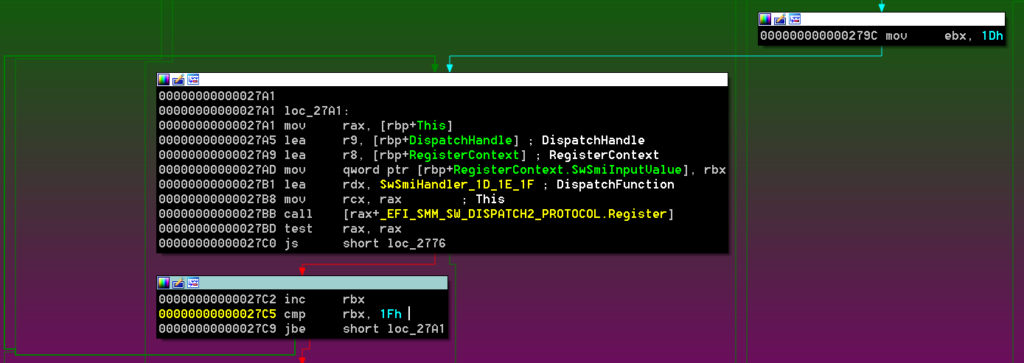
This module registers a single SW SMI handler for three different SwSmiInputs (0x1D, 0x1E, 0x1F) via EFI_SMM_SW_DISPATCH2_PROTOCOL:
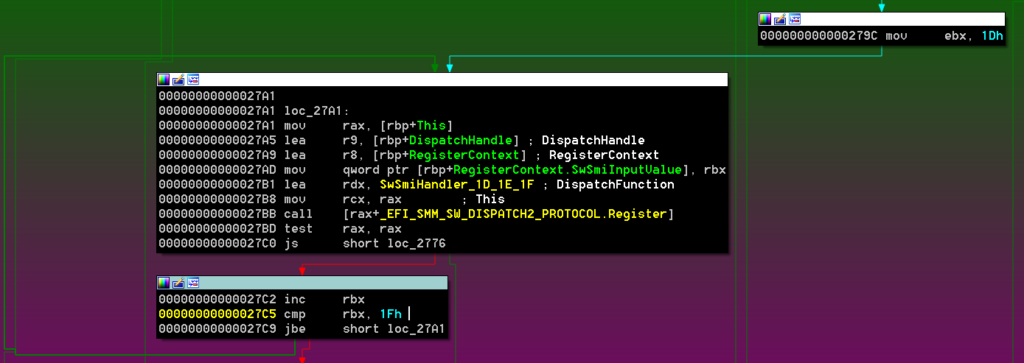
Based on public information about this module, the above operations map to:
– 0x1D – LOAD_IMAGE
– 0x1E – GET_POLICY
– 0x1F – SET_POLICY
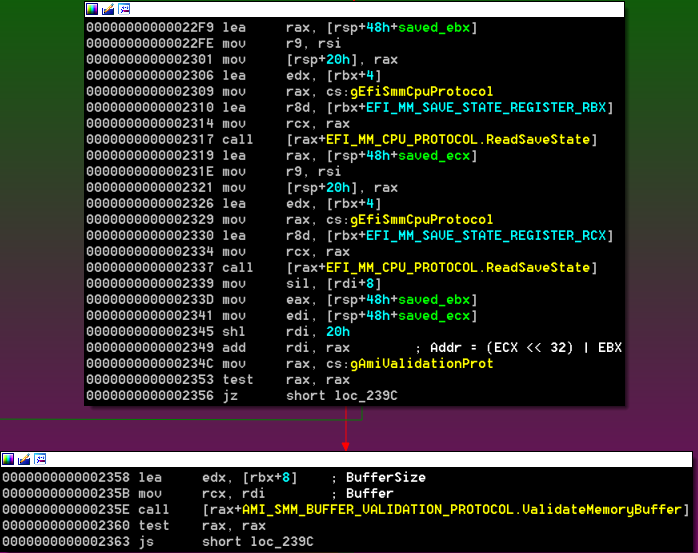
The handler uses EFI_MM_CPU_PROTOCOL to read the contents of the saved ECX and EBX registers and create a 64-bit pointer. This constructed buffer is verified to be exactly 8 bytes long and outside SMRAM using AMI_SMM_BUFFER_VALIDATION_PROTOCOL:
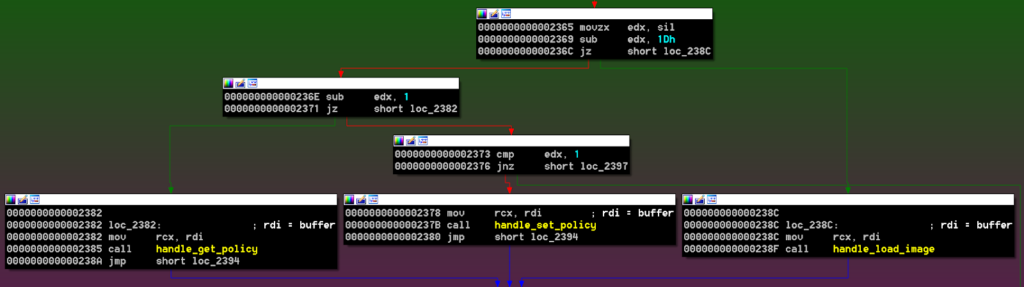
Depending on the value written on the SW-SMI triggering port (SwSmiInput), the execution continues in handle_load_image (0x1D), handle_get_policy (0x1E), or handle_set_policy (0x1F). These three functions receive a single argument which is the constructed pointer from the previous step:
The three operations have security issues.
Let’s start with handle_load_image. As part of its initialization, SecSMIFlash allocates 0x1001 pages of memory (g_pBufferImage) that are going to be used to store the BIOS image file.
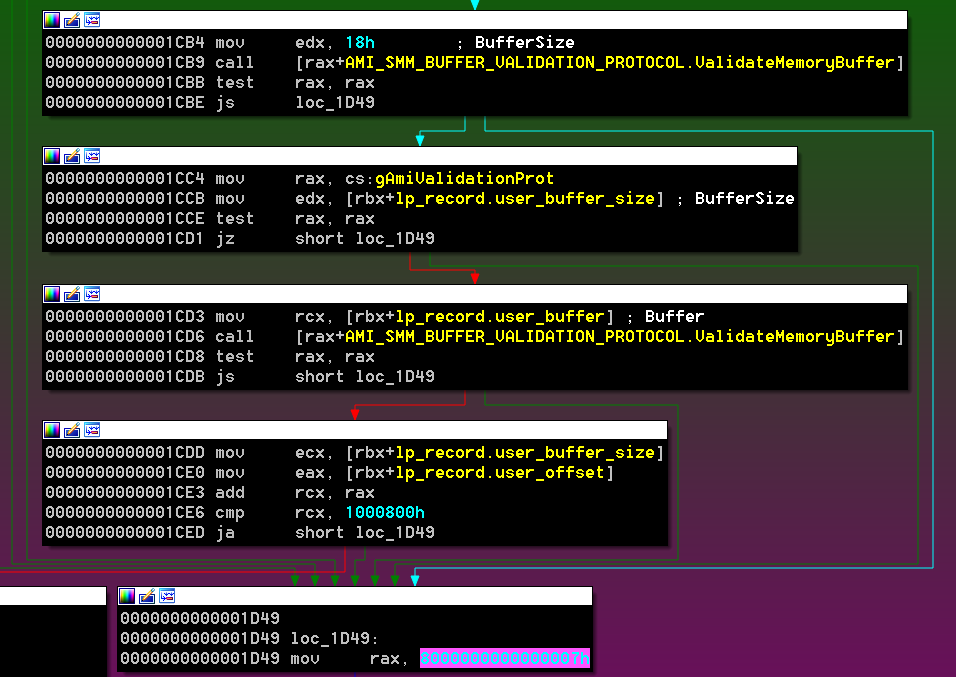
The buffer address is put into RBX and then validated again but this time it checks that the size is at least 0x18 bytes (outside SMRAM).
The buffer is used as a record defined as follows:
Another pointer is extracted from memory (the user_buffer member), which is validated to be user_buffer_size bytes, followed by a check that attempts to make sure that the provided offset and size are within the allocated bounds of g_pBufferImage.
The problem is that there is a time-of-check to time-of-use (TOCTOU) condition that can be abused:
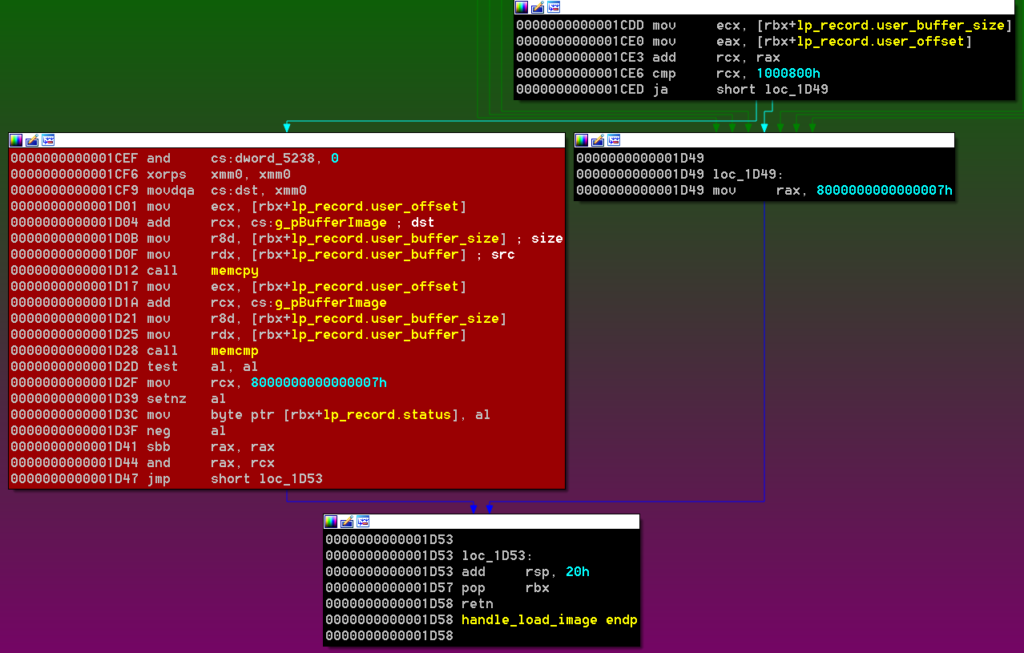
The block of code that performs the checks does not make local copies of the values into SMRAM. The values are retrieved again from user-controlled memory when the copy is done, which means the values could have changed.
Exploitation of this issue requires the use of a DMA agent.
In the case of the handle_get_policy operation, the code presents a vulnerability in the first basic block:
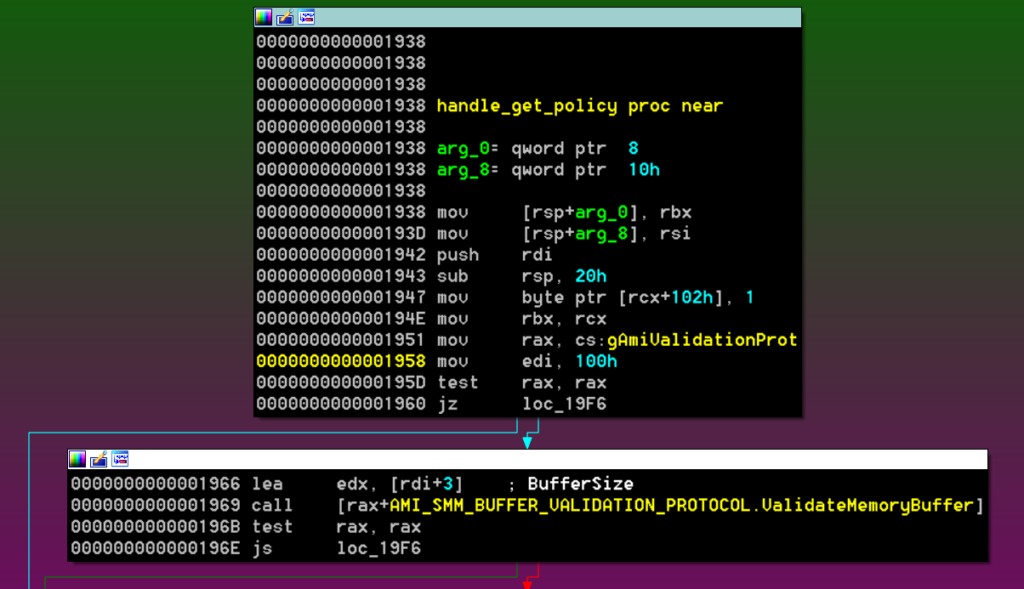
Previously, the buffer was verified to only 8 bytes outside SMRAM, but here the code writes the value 1 at offset +102h and the ValidateMemoryBuffer check happens afterwards. Moreover, if ValidateMemoryBuffer fails, the handler simply bails out without doing anything else.
This out-of-bounds write condition allows the first 250 bytes (102h – 8) of the TSEG region to be written. The bottom of the TSEG region contains the SMM_S3_RESUME_STATE structure:
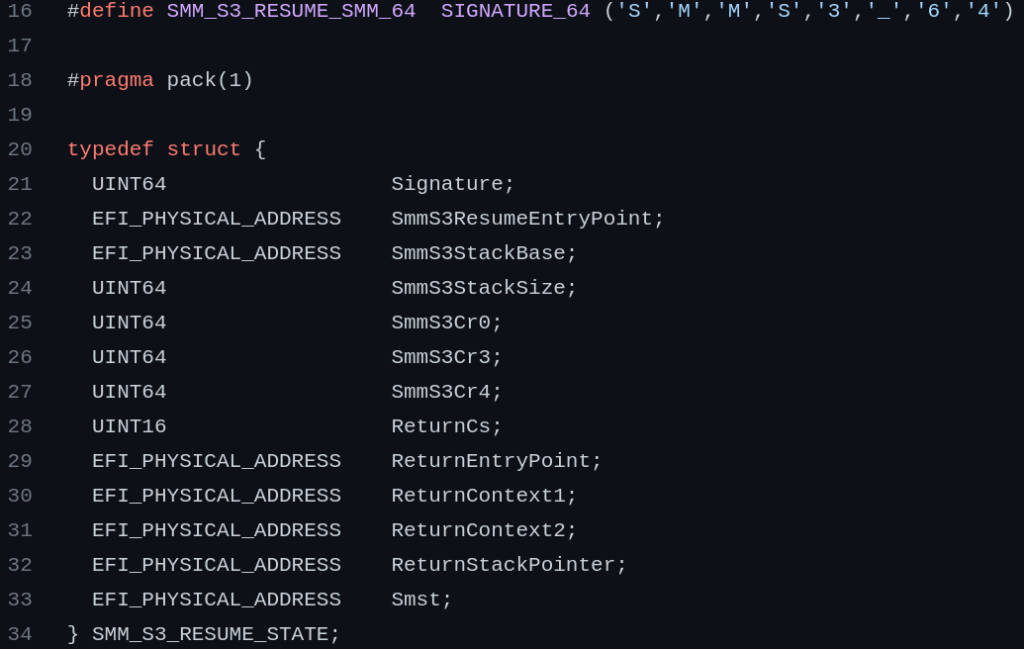
There are several EFI_PHYSICAL_ADDRESS pointers that could be targeted to achieve arbitrary SMM code execution.
The following PoC code uses Platbox and the above primitive to write ones to the first 250 bytes of the TSEG region (0xef000000 in the machine used for testing):
Finally, for the handle_set_policy operation, the code suffers from a combination of the issues described above.
Responsible Disclosure Attempt
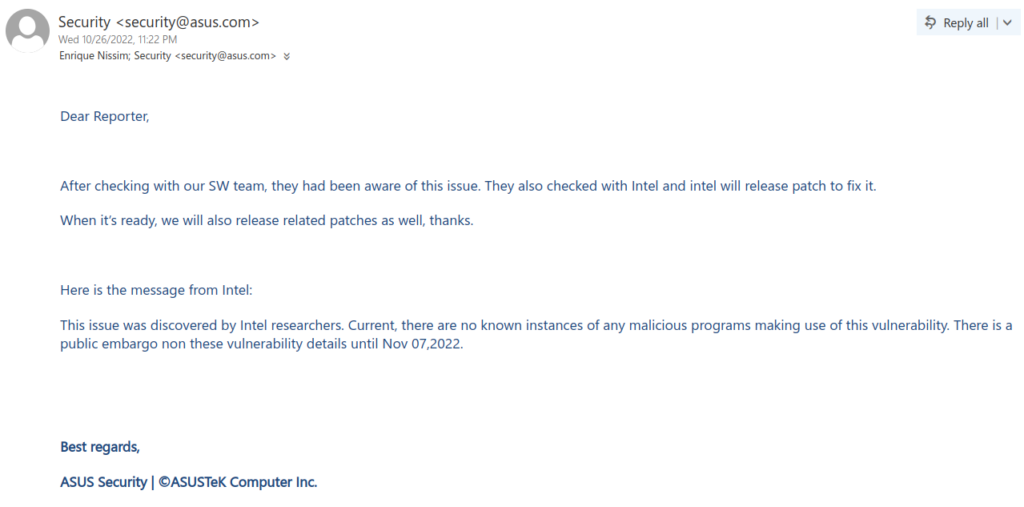
IOActive drafted a technical document and sent it over to ASUS. After a few weeks, ASUS replied with the following:
The response left us with some concerns:
1. They claimed all the reported issues were known by the team.2. There was no ETA for the patch.3. The issues were discovered by Intel and there was an embargo?4. Is there a CVE assigned to track these?
We replied with a few questions along these lines and their response made it clear that the module is entirely handled by AMI and that Intel researchers may or may not apply a CVE number.
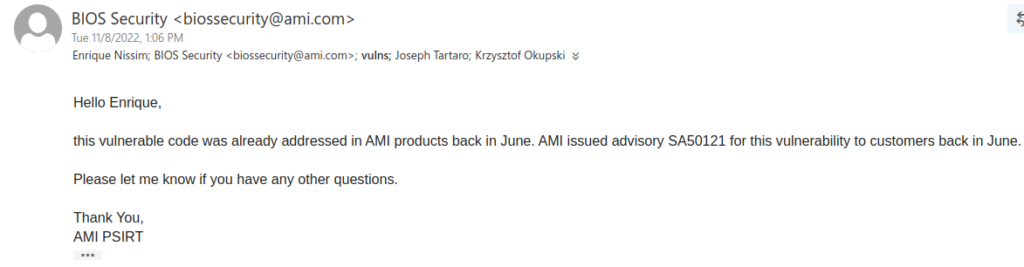
On the other hand, AMI provided a much quicker response, although quite unexpected:
Thursday, February 16, 2023
Adventures in the Platform Security Coordinated Disclosure Circus
by Enrique Nissim, Krzysztof Okupski and Joseph Tartaro
Platform security is one of the specialized service lines IOActive offers and we have worked with many vendors across the industry. Lately, we have been conducting research on various targets while developing tooling that we believe will help the industry make platform security improvements focused on AMD systems.
In early October 2022, IOActive reported a number of security issues to ASUS and AMI in an SMM module called SecSMIFlash (GUID 3370A4BD-8C23-4565-A2A2-065FEEDE6080). SecSMIFlash is included in BIOS image G513QR.329 for the ASUS Rog Strix G513QR. This module garnered some attention after Alexander Matrosov (BlackHat USA 2017) demonstrated how the SMI handlers failed to check input pointers with SmmIsBufferOutsideSmmValid(), resulting in CVE-2017-11315.
IOActive discovered issues on one of our target platforms, a fully updated ASUS Rog Strix G513QR, while running an internally developed dumb SW SMI fuzzer. Almost immediately, the system appeared to hang on SMI handler 0x1D.
This module registers a single SW SMI handler for three different SwSmiInputs (0x1D, 0x1E, 0x1F) via EFI_SMM_SW_DISPATCH2_PROTOCOL:
Based on public information about this module, the above operations map to:
– 0x1D – LOAD_IMAGE
– 0x1E – GET_POLICY
– 0x1F – SET_POLICY
The handler uses EFI_MM_CPU_PROTOCOL to read the contents of the saved ECX and EBX registers and create a 64-bit pointer. This constructed buffer is verified to be exactly 8 bytes long and outside SMRAM using AMI_SMM_BUFFER_VALIDATION_PROTOCOL:
Depending on the value written on the SW-SMI triggering port (SwSmiInput), the execution continues in handle_load_image (0x1D), handle_get_policy (0x1E), or handle_set_policy (0x1F). These three functions receive a single argument which is the constructed pointer from the previous step:
The three operations have security issues.
Let’s start with handle_load_image. As part of its initialization, SecSMIFlash allocates 0x1001 pages of memory (g_pBufferImage) that are going to be used to store the BIOS image file.
The buffer address is put into RBX and then validated again but this time it checks that the size is at least 0x18 bytes (outside SMRAM).
The buffer is used as a record defined as follows:
Another pointer is extracted from memory (the user_buffer member), which is validated to be user_buffer_size bytes, followed by a check that attempts to make sure that the provided offset and size are within the allocated bounds of g_pBufferImage.
The problem is that there is a time-of-check to time-of-use (TOCTOU) condition that can be abused:
The block of code that performs the checks does not make local copies of the values into SMRAM. The values are retrieved again from user-controlled memory when the copy is done, which means the values could have changed.
Exploitation of this issue requires the use of a DMA agent.
In the case of the handle_get_policy operation, the code presents a vulnerability in the first basic block:
Previously, the buffer was verified to only 8 bytes outside SMRAM, but here the code writes the value 1 at offset +102h and the ValidateMemoryBuffer check happens afterwards. Moreover, if ValidateMemoryBuffer fails, the handler simply bails out without doing anything else.
This out-of-bounds write condition allows the first 250 bytes (102h – 8) of the TSEG region to be written. The bottom of the TSEG region contains the SMM_S3_RESUME_STATE structure:
There are several EFI_PHYSICAL_ADDRESS pointers that could be targeted to achieve arbitrary SMM code execution.
The following PoC code uses Platbox and the above primitive to write ones to the first 250 bytes of the TSEG region (0xef000000 in the machine used for testing):
Finally, for the handle_set_policy operation, the code suffers from a combination of the issues described above.
Responsible Disclosure Attempt
IOActive drafted a technical document and sent it over to ASUS. After a few weeks, ASUS replied with the following:
The response left us with some concerns:
1. They claimed all the reported issues were known by the team.
2. There was no ETA for the patch.
3. The issues were discovered by Intel and there was an embargo?
4. Is there a CVE assigned to track these?
We replied with a few questions along these lines and their response made it clear that the module is entirely handled by AMI and that Intel researchers may or may not apply a CVE number.
On the other hand, AMI provided a much quicker response, although quite unexpected:
We attempted to look for advisory SA50121 but did not find anything. It is probably only available to vendors. What is surprising though, is they say that a fix was released in June.