


The Basics
gRPC is an open-source RPC framework from Google which leverages automatic code generation to allow easy integration to a number of languages. Architecturally, it follows the standard seen in many other RPC frameworks: services are defined which determine the available RPCs. It uses HTTP version 2 as its transport, and supports plain HTTP as well as HTTPS for secure communication. Services and messages, which act as the structures passed to and returned by defined RPCs, are defined as protocol buffers. Protocol buffers are a common serialization solution, also designed by Google.
Protocol Buffers
Serialization using protobufs is accomplished by definining services and messages in .proto files, which are then used by the protoc protocol buffer compiler to generate boilerplate code in whatever language you’re working in. An example .proto file might look like the following:
// Declares which syntax version is to follow; read by protoc
syntax = "proto3";

// package name allows for namespacing to avoid conflicts
// between message types. Will also determine namespace in C++
package stringmanipulation;


// The Service definition: this specifies what RPCs are offered
// by the service
service StringManipulation {

    // First RPC. RPC definitions are like function prototypes:
    // RPC name, argument types, and return type is specified.
    rpc reverseString (StringRequest) returns (StringReply) {}

    // Second RPC. There can be arbitrarily many defined for
    // a service.
    rpc uppercaseString (StringRequest) returns (StringReply) {}
}

// Example of a message definition, containing only scalar values.
// Each message field has a defined type, a name, and a field number.
message innerMessage {
    int32 some_val = 1;
    string some_string = 2;
}

// It is also possible to specify an enum type. This can
// be used as a member of other messages.
enum testEnumeration {
    ZERO = 0;
    ONE = 1;
    TWO = 2;
    THREE = 3;
    FOUR = 4;
    FIVE = 5;
}

// messages can contain other messages as field types.
message complexMessage {
    innerMessage some_message = 1;
    testEnumeration innerEnum = 2;
}

// This message is the type used as the input to both defined RPCs.
// Messages can be arbitrarily nested, and contain arbitrarily complex types.
message StringRequest {
    complexMessage cm = 1;
    string original = 2;
    int64 timestamp = 3;
    int32 testval = 4;
    int32 testval2 = 5;
    int32 testval3 = 6;
}

// This message is the type for the return value of both defined RPCs.
message StringReply {
    string result = 4;
    int64 timestamp = 2;
    complexMessage cm = 3;
}
There is a lot more to protocol buffers and the available options, if you’re interested Google has a very good language guide.
gRPC
gRPC is an RPC implementation designed to use protobufs to take care of all boilerplating necessary for implementation, as well as provided functions to manage the connection between the RPC server and its clients. The majority of compiled code in a gRPC server binary will likely be either gRPC library code and autogenerated classes, stubs etc. created with protoc. Only the actual implementation of RPCs is required of the developer and accomplished by extending the base Service class generated by protoc based on the definitions in .proto files..
Transport
gRPC uses HTTP2 for transport, which can either be on top of a TLS connection, or in the clear. gRPC also supports mTLS out of the box. What type of channel is used is configured by the developer while setting up the server/client.
Authentication
As mentioned above, gRPC support mTLS, wherein both the server and the client are identified based on exchanged TLS certificates. This appears to be the most common authentication mechanism seen in the wild (though “no authentication” is also popular). gRPC also supports Google’s weird ALTS which I’ve never seen actually being used, as well as token-based authentication.
It is also possible that the built-in authentication mechanisms will be eschewed for a custom authentication mechanism. Such a custom implementation is of particular interest from a security perspective, as the need for a custom mechanism suggests a more complex (and thus more error prone) authentication requirement.
gRPC Server Implementation
The following will be an overview of the major parts of a gRPC server implementation in C++. A compiled gRPC server binary can be extremely difficult to follow, thanks to the extensive automatically generated code and heavy use of gRPC library functions. Understanding the rough structure that any such server will follow (important function calls and their arguments) will greatly improve your ability to make sense of things and identify relevant sections of code which may present an attack surface.
Server Setup
The following is the setup boilerplate for a simple gRPC server. While a real implementation will likely be more complex, the function calls seen here will be the ones to look for in unraveling the code.
void RunServer() {
    std::string listen = "127.0.0.1:50006";
    // This is the class defined to implement RPCs, will be covered later
    StringManipulationImpl service;

    ServerBuilder builder;

    builder.AddListeningPort(listen, grpc::InsecureServerCredentials());
    builder.RegisterService(&service);

    std::unique_ptr<grpc::Server> server(builder.BuildAndStart());
    std::cout << "Server listening on port: " << listen << "\n";
    server->Wait();
}builder.AddListeningPort: This function sets up the listening socket as well as handling the transport setup for the channel. arg1:addr_uri: a string composed of the IP address and port to listen on, separated by a colon. i.e. “127.0.0.1:50001”- arg2:
creds: The credentials associated with the server. The function call used here to generate credentials will indicate what kind of transport is being used, as follows:InsecureServerCredentials: No encryption; plain HTTP2 SslServerCredentials: TLS is in use, meaning the client can verify the server and communication will be encrypted. If client authentication (mTLS) is to be used, relevant options will be passed to this function call. For example, settingopts.client_certificate_requesttoGRPC_SSL_REQUEST_AND_REQUIRE_CLIENT_CERTIFICATE_AND_VERIFYwill require the client supply a valid certificate. Any potential vulnerabilities at this point will be in the options passed to the SslServerCredentials constructor, and will be familiar to any consultant. Do they verify the client certificate? Are self-signed certificates allowed? etc., standard TLS issues.
RPC Implementation
The following is the implementation of the StringManipulationImpl instance passed to RegisterService above.
class StringManipulationImpl : public stringmanipulation::StringManipulation::Service {
    Status reverseString(ServerContext *context,
                         const StringRequest *request,
                         StringReply *reply) {


        std::string original = request->original();
        std::string working_copy = original;
        std::reverse(working_copy.begin(), working_copy.end());
        reply->set_result(working_copy);

        struct timeval tv;
        gettimeofday(&tv, NULL);

        printf("[%ld|%s] reverseString(\"%s\") -> \"%s\"\n",
                tv.tv_sec,
                context->peer().c_str(),
                request->original().c_str(),
                working_copy.c_str());

        return Status::OK;
    }

    Status uppercaseString(ServerContext *context,
                           const StringRequest *request,
                           StringReply *reply) {

        std::string working_copy = request->original();
        for (auto &c: working_copy) c = toupper(c);
        reply->set_result(working_copy.c_str());

        struct timeval tv;
        gettimeofday(&tv, NULL);

        printf("[%ld|%s] uppercaseString(\"%s\") -> \"%s\"\n",
                tv.tv_sec,
                context->peer().c_str(),
                request->original().c_str(),
                working_copy.c_str());

        return Status::OK;

    }
};
Here we see the implementation for each of the two defined RPCs for the StringManipulation service. This is accomplished by extending the base service class generated by protoc. gRPC implementation code like this will often follow this naming scheme, or something like it — the service name, appended by “Impl,” “Implementation,” etc.
Static Analysis
Finding Interesting Logic
These functions, generally, are among the most interesting targets in any test of a gRPC service. The bulk of the logic baked into a gRPC binary will be library code, and these functions which will actually be parsing and handling the data transmitted via the gRPC link. These functions can be located/categorized by looking for calls to builder.RegisterService.

Here we see just one call, because the example is simple, but in a more complex implementation there may be many calls to this function. Each one represents a particular service being made available, and will allow for the tracking down of the implementations of each RPC for those services. Navigating to the cross reference address, we see that an object is being passed to this function. Keep in mind this binary has been pre-annotated for clarity and the initial output of the reverse engineering tool will likely be less clear. However the function calls we care about should be clear enough to follow without much effort.
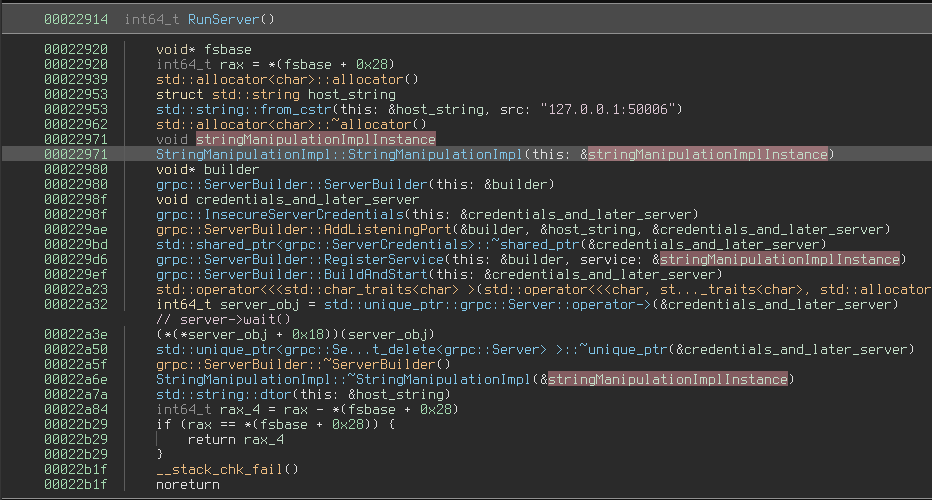
We see that before being passed to RegisterService, the stringManipulationImplInstance (name added by me) is being passed to a function, StringManipulationImpl::StringManipulationImpl. Based both on the context and the demangled name, this is a constructor for whatever class this is. We can see the constructor itself is very simple:

The function calls another constructor (the base class constructor) on the passed object, then sets the value at object offset 0. In C++, this offset is usually (and in this case) reserved for the class’s vtable. Navigating to that address, we can see it:

Because this binary is not stripped, the actual names of the functions (matching the RPCs) are displayed. With a stripped binary, this is not the case, however an important quirk of the gRPC implementation results in the vtables for service implementations always being structured in a particular way, as follows.
- The first two entries in the vtable are constructor/destructors.
- Each subsequent entry is one of the custom RPC implementations, in the order that they appear in the .proto file. This means that if you are in possession of the .proto file for a particular service, even if a binary is stripped, you can quickly identify which implementation corresponds to which RPC. And if you don’t have the .proto file, but do have the binary, there is tooling available which is very effective at recovering .proto files from gRPC binaries, which will be covered later. This is helpful not only because you may get a hint at what the RPC does based on its name, but also because you will know the exact types of each of the arguments.
Anatomy of an RPC
There are a few details which will be common to all RPC implementations which will aid greatly in reverse engineering these functions. The first are the arguments to the functions:
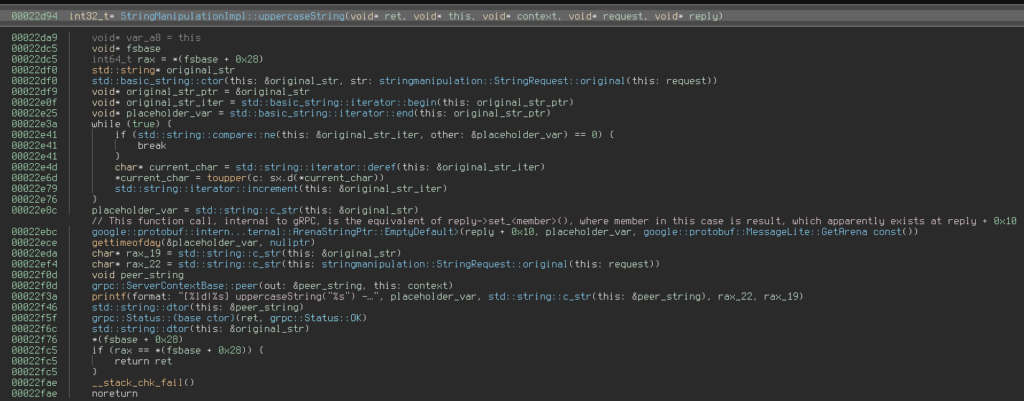
- Argument 1: Return value, usually of type grpc::Status. This is a C++ ABI thing, see section 3.1.3.1 of the Itanium C++ ABI Spec. Tracking sections of the code which write to this argument may be helpful in understanding authorization logic which may be baked into the function, for example if a function is called, and depending on its return value, arg1 is set to either grpc::Status::OK or grpc::Status::CANCELLED, that function may have something to do with access controls.
- Argument 2: The
thispointer. Points to the instance of whatever service class the RPC is a method on. - Argument 3: ServerContext. From the gRPC documentation:A ServerContext or CallbackServerContext allows the code implementing a service handler to:Add custom initial and trailing metadata key-value pairs that will propagated to the client side.
- Control call settings such as compression and authentication.
- Access metadata coming from the client.Get performance metrics (ie, census).
Note: In addition to unary RPCs (a single request object and single response object), gRPC also supports streaming RPCs. In the case of unidirectional streams, i.e. where only one of the request or response is a stream, the number of arguments and order is the same, and only the type of one of the arguments will differ. For client-side streaming (i.e. the request is streamed) Argument 4 will be wrapped with a ServerReader, so in this example it will be of type ServerReader<StringRequest>. For Server side streaming (streamed response), it will be wrapped with a ServerWriter, so ServerWriter<StringReply>.
For bidirectional streams, where both the request and the response are streamed, the number of arguments differ. Rather than a separate argument for request and response, the function only has four arguments, with the forth being a ServerReaderWriter wrapping both types. In this example, ServerReaderWriter<StringRequest, StringReply>. See the gRPC documentation for more information on these wrappers. The C++ Basics Tutorial has some good examples.
Protobuf Member Accesses in C++
The classes generated by protoc for each of the input/output types defined in the .proto file are fairly simple. Scalar typed members are stored by value as member variables inside the class instance. Non-scalar values are stored as pointers to the member. The class includes (among other things) the following functions for getting and setting members:
.<member>(): get the value of the field with name<member>. This is applicable to all types, and will return the value itself for scalar types and a pointer to the member for complex/allocated types..set_<member>(value_to_set): set the value for a type which does not require allocation. This includes scalar fields and enums..set_allocated_<member>(value_to_set): set the value for a complex type, which requires allocation and setting of its own member values prior to setting in the request or reply. This is for composite/nested types.
The actual implementation for these functions is fairly uncomplicated, even for allocated types, and basically boils down to accessing the value of a pointer at some offset into the object whose member is being retrieved or set. These functions will not be named in a stripped binary, but are easy to spot.
The getters take the request message (in this example, request) as the sole argument, pass it through a couple of nested function calls, and eventually make an access to some offset into the message. Based on the offset, you can determine which field is being accessed, (with the help of the generated pb.h files, generation of which is covered later) and can thus identify the function and its return value.
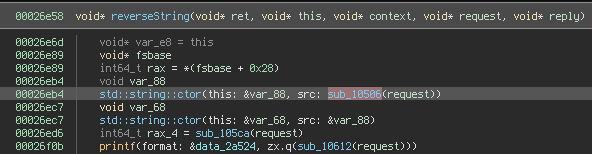


The implementation for complex types is similar, adding a small amount of extra code to account for allocation issues.


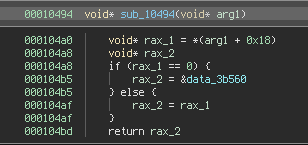
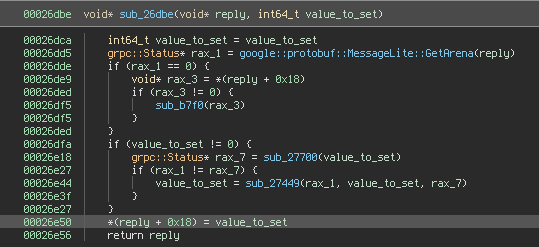
Setter functions follow an almost identical structure, with the only difference being that they take the response message (in this example, reply) as the first argument and the value to set the field to as the second argument.



And again, the only difference for complex type setters is a bit of extra logic to handle allocation when necessary.
Reconstructing Types
The huge amount of automatically generated code used by gRPC is a great annoyance to a prospective reverse engineer, but it can also be a great ally. Because the manner in which the .proto files are integrated into the final binary is uniform, and because the binary must include this information in some form to correctly deserialize incoming messages, it is possible in most cases to extract a complete reconstruction of the original .proto file from any software which uses gRPC for communication, whether that be a client or server.
This can be done manually with some studying up on protobuf Filedescriptors, but more than likely this will not be necessary — someone has probably already written something to do it for you. For this guide the Protobuf Toolkit (pbtk) will be used, but a more extensive list of available software for extracting .proto structures from gRPC clients and servers will be included in the Tooling section.
Generating .proto Files
By feeding the server binary we are working with into pbtk, the following .proto file is generated.
syntax = "proto3";

package stringmanipulation;

service StringManipulation {
    rpc reverseString(StringRequest) returns (StringReply);
    rpc uppercaseString(StringRequest) returns (StringReply);
}

message innerMessage {
    int32 some_val = 1;
    string some_string = 2;
}

message complexMessage {
    innerMessage some_message = 1;
    testEnumeration innerEnum = 2;
}

message StringRequest {
    complexMessage cm = 1;
    string original = 2;
    int64 timestamp = 3;
    bool testval = 4;
    bool testval2 = 5;
    bool testval3 = 6;
}

message StringReply {
    string result = 4;
    int64 timestamp = 2;
    complexMessage cm = 3;
}

enum testEnumeration {
    ZERO = 0;
    ONE = 1;
    TWO = 2;
    THREE = 3;
    FOUR = 4;
    FIVE = 5;
}