

What is an FPGA?
Field-Programmable Gate Arrays (FPGAs) are a type of Integrated Circuit (IC) that can be programmed or reprogrammed after manufacturing. They consist of an array of logic blocks and interconnects that can be configured to perform various digital functions. FPGAs are commonly used in applications where flexibility, speed, and parallel processing capabilities are required, such as telecommunications, automotive, aerospace, and industrial sectors.
FPGAs are often found in products that are low volume or demand short turnaround time because they can be purchased off the shelf and programmed as needed without the setup and manufacturing costs and long lead times associated with Application-Specific Integrated Circuits (ASICs). FPGAs are also popular for military and aerospace applications due to the long lifespan of such hardware as compared to typical consumer electronics. The ability to update deployed systems to meet new mission requirements or implement new cryptographic algorithms—without replacing expensive hardware—is valuable.
These benefits come at a cost, however: additional hardware is required to enable reprogramming. An FPGA-based design will use many more transistors than the same design implemented as an ASIC, increasing power consumption and per-device costs.
Implementing a circuit with an FPGA vs an ASIC can also come with security concerns. FPGA designs are compiled to a “bitstream,” a digital representation of the circuit netlist, which must be loaded into the FPGA for it to function. While bitstream formats are generally undocumented by the manufacturer, several projects are working towards open-source toolchains (e.g., Project X-Ray for the Xilinx 7 series) and have reverse engineered the bitstream formats for various devices.
FPGA bitstreams can be loaded in many ways, depending on the FPGA family and application requirements:
- Serial or parallel interfaces from an external processor
- JTAG from a debug cable attached to a PC
- Serial or parallel interfaces to an external flash memory
- Separate stacked-die flash memory within the same package as the FPGA
- Flash or One-Time-Programmable (OTP) memory integrated into the FPGA silicon itself
In this post, we will focus on Xilinx because it was the first company to make a commercially viable FPGA back in 1985 and continues to be a world leader in the field. AMD acquired Xilinx in 2020 in a deal worth $60 billion, and today they control over 50% of the world’s programmable logic chips.
The Spartan™ 6 family of Xilinx FPGAs offers low-cost and low-power solutions for high-volume applications like displays, military/emergency/civil telecommunications equipment, and wireless routers. Spartan 6 was released in 2009, so these chips are relatively low-tech compared with their successors, the Spartan 7 and Xilinx’s higher end solutions (e.g., the Zynq and Versal families).
The Spartan 6 bitstream format is not publicly known, but IOActive is aware of at least one research group with unreleased tooling for it. These devices do not contain internal memory, so the bitstream must be provided on external pins each time power is applied and is thus accessible for an attacker to intercept and potentially reverse engineer.
FPGA vendors are, of course, aware of this risk and provide security features, such as allowing bitstreams to be encrypted on external flash and decrypted on the FPGA. In the case of the Spartan 6 family, the bitstream can be encrypted with AES-256 in CBC mode. The key can be stored in either OTP eFuses or battery-backed Static Random Access Memory (SRAM), which enables a self-destruct function where the FPGA can erase the key if it detects tampering.
The AES block used in the Spartan 6, however, is vulnerable to power analysis, and a team of German researchers developed a successful attack against it: “On the Portability of Side-Channel Attacks – An Analysis of the Xilinx Virtex 4, Virtex 5, and Spartan 6 Bitstream Encryption Mechanism.”
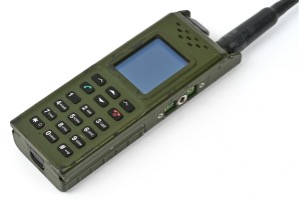
An example of a Xilinx Spartan 6 application is the Russian military radio R-187-P1 made by Angstrem, so we decided to use this as our test case.
AZART R-187-P1 Product Overview
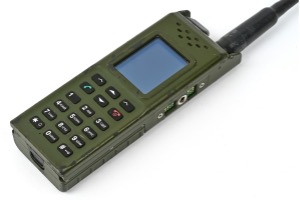
Since its release in 2012, several researchers have discovered that the radio provides built-in protocols to allow communication across multiple standards, including older analogue Russian radios, UAV commands, and even TETRA. While the advertised frequency range is 27 to 520 MHz, recent firmware updates enabled a lower range of frequencies down to 100 kHz with AM.
The features of this radio are fairly well known. The following was posted by @SomeGumul, a Polish researcher, on Twitter/X:
The trophy in the form of the Russian radio station “Azart”, announced by the Russians as a “native, Russian” sixth-generation device for conducting encrypted conversations, works on American radio components. The basis of the encryption system is, in particular, the Spartan®-6 FPGA (field-programmable gate array) system. It is produced by the American company XILINX (AMD) in Taiwan.
Ironically, despite being advertised as the forefront of Russia’s military technical prowess, the heart of this device was revealed by Ukrainian serviceman Serhii Flash (Сергей Флэш) to be powered by the Spartan 6 FPGA. This FPGA is what enables the handheld radio’s capabilities to be redefined by mere software updates, allowing its users to speak over virtually any radio standard required—past, present, or future. While most of the currently implemented protocols are unencrypted to allow backward compatibility with other older, active service equipment, communication between two AZART radios enables frequency hopping up to 20,000 frequencies per second. This high rate of frequency hopping creates challenges for eavesdropping and position triangulation. The radio’s implementation of TETRA also supports encryption with the inclusion of a supporting radio trunk, where the radio is referred to as being in Trunked Mode Operation (TMO). Otherwise, while in Direct Mode Operation (DMO), the radio only supports voice scrambling in the time and frequency domains.
20,000 frequency hops per second is quite a feat for a radio. Extremely precise timing is required for two or more radios to sync across hops and still communicate clearly. This timing source is gained wirelessly from GPS and GLONASS. As such, this advanced feature can be disabled simply by jamming GPS frequencies.
While this attack may be sufficient, GPS signals are ubiquitous and neutral sources of precise timing that are often required by both sides of any conflict. So, while jamming the frequencies may work in a pinch, it would be cleaner to find a solution to track this high rate of frequency hopping without having to jam a useful signal. To find this solution, we must investigate the proprietary Angstrem algorithm that drives the pseudo-random frequency hopping. To do this, we begin by looking at the likely driver: the Spartan 6 FPGA.