

Sometimes when buying something that costs $0.99 USD (99 cents) or $1.01 USD (one dollar and one cent), you may pay an even dollar. Either you or the cashier may not care about the remaining penny, and so one of you takes a small loss or profit.
IEEE 754 standard has defined floating point numbers for more than 30 years. The requirements that guided the formulation of the standard for binary floating-point arithmetic provided for the development of very high-precision arithmetic.
The standard defines how operations with floating point numbers should be performed, and also defines standard behavior for abnormal operations. It identifies five possible types of floating point exceptions: invalid operation (highest priority), division by zero, overflow, underflow, and inexact (lowest priority).
- JavaScript has a reference about this in the W3C Schools.
- Python has an excellent explanation about the difficulties of representing certain decimal numbers in binary format.
- Ruby clearly states that floating point has a different arithmetic and is a inexact number.

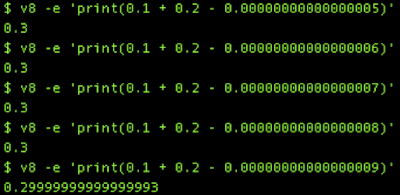
Salami slicing refers to a series of small actions that will produce a result that would be impossible to perform all at once. In this case, we will grab the smallest amount of decimals that are being ignored by the programming language and use that for profit.


But what happens if we are greedy? How much can we take without JavaScript noticing?